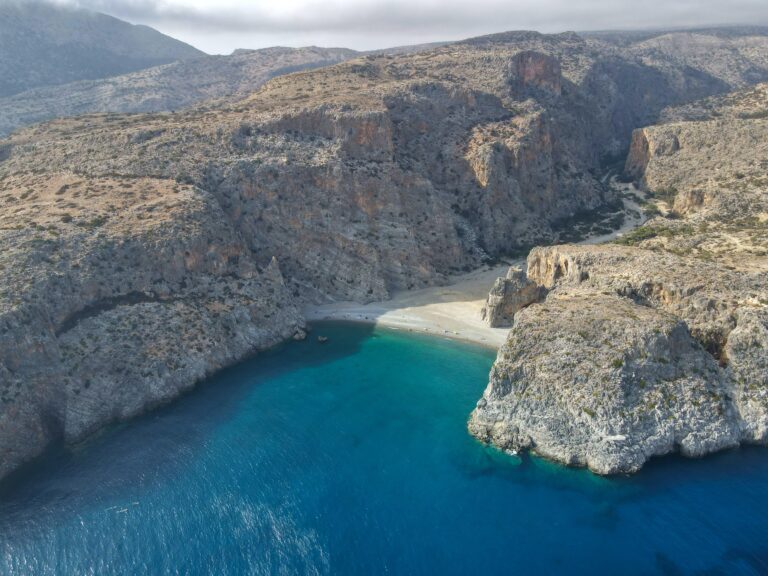
Most people who come to Crete already know it is beautiful. What surprises them is how deep it goes.
Thirty-five years of living on this island has taught me that Crete is not simply a place with a long history — it is a place where history is still physically present, still visible in the landscape, still woven into the character of the people. And the deepest roots of all belong to a civilisation that flourished here more than three and a half thousand years ago, centuries before ancient Athens, long before Rome — a civilisation that was, in the truest sense, the beginning of Europe.
The Minoans. If you are coming to Crete and you have not yet heard of them, this article will change your trip. And if you have heard of them but assumed they were just another ancient ruin to tick off a list, I hope to convince you otherwise.
“The Minoans had running water, multi-storey palaces, and fresco paintings of breathtaking sophistication — while most of Europe was still living in wooden huts.”
Who Were the Minoans?
The Minoan civilisation emerged on Crete around 3000 BCE and reached its extraordinary peak between roughly 1700 and 1450 BCE. They were, by any measure, the first advanced civilisation in Europe — predating classical Greece by more than a thousand years, and in many ways more sophisticated than what came after them.
The name Minoan is not what they called themselves. It was coined in the early twentieth century by the British archaeologist Arthur Evans, who named the culture after the legendary King Minos of Greek mythology. Whether Minos was a real historical figure, a dynasty title or purely myth remains one of the many unresolved questions that make the Minoans so endlessly fascinating. We do not even know what language they spoke — their primary writing system, known as Linear A, has never been fully deciphered. This is a civilisation that, in some fundamental ways, is still speaking to us in a language we cannot yet read.
What we do know is remarkable. The Minoans built monumental palace complexes with sophisticated drainage systems, indoor plumbing and multi-storey architecture. They painted their walls with vivid, joyful frescoes unlike anything produced in Europe at the time. They ran a trading empire that stretched from Egypt and the Levant to Cyprus, mainland Greece and as far as Spain. Their ships were the most advanced in the Mediterranean. And unlike almost every other major Bronze Age civilisation, they appear to have done most of this without maintaining a significant military. No fortifications. No weapons caches. Just trade, art, ceremony and a seemingly deep relationship with the natural world.
The Palaces — Starting with Knossos
Knossos: The Heart of the Minoan World
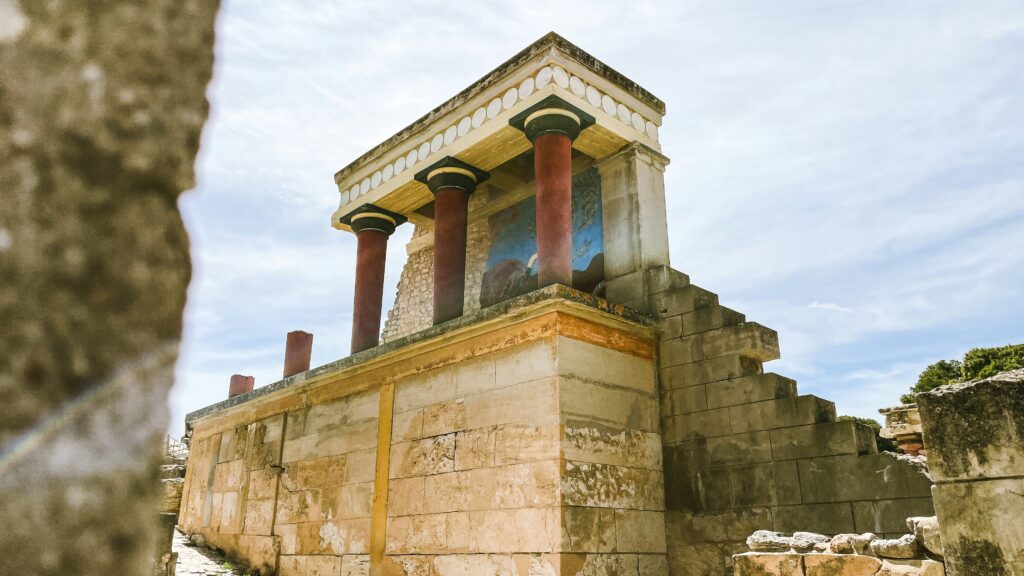
The Palace of Knossos, located just five kilometres south of modern Heraklion, is the largest Bronze Age archaeological site on Crete and one of the most visited in all of Greece, drawing over a million visitors a year. At its height, Knossos was home to between twenty and one hundred thousand people — a genuinely enormous population for the ancient world — and the palace itself contained over a thousand rooms.
Walking through the site today, even partly reconstructed as it is, gives you a visceral sense of the scale and ambition of what was built here. The Throne Room, with its alabaster seat and flanking frescoes of griffins, is one of the most evocative spaces in all of ancient archaeology. The Grand Staircase descends into residential quarters that feel, astonishingly, almost liveable — light wells designed to bring natural light deep into the building, drainage channels that still function, storage magazines that once held thousands of litres of olive oil and wine.
Evans controversially restored large sections of the palace in reinforced concrete during his excavations from 1900 onwards — a decision that remains debated among archaeologists but that undeniably makes Knossos more legible to the modern visitor than any other Minoan site. You can see what a palace looked like. You can begin to grasp what it felt like to live here.
“Knossos had over a thousand rooms, a working drainage system, and light wells that brought sunshine into its deepest chambers — around 1600 BCE.”
Phaistos, Malia and Zakros — The Other Palaces
Knossos was not the only Minoan palace on Crete. Major palace complexes were also built at Phaistos in the south, Malia on the north coast, and Zakros in the far east of the island. Each had its own sphere of influence, its own administrative apparatus and its own distinctive character.
Phaistos, set dramatically on a hilltop overlooking the Mesara plain, is arguably the most beautiful archaeological site on the island. Less reconstructed than Knossos, it feels more authentically ancient — the view from the west court alone, across the plain to the mountains beyond, is reason enough to make the trip. It is here that the famous Phaistos Disc was discovered in 1908: a fired clay disc covered in a spiral sequence of stamped symbols that represents, to this day, one of the great undeciphered mysteries of the ancient world.
Minoan Art: A Civilisation That Loved Beauty
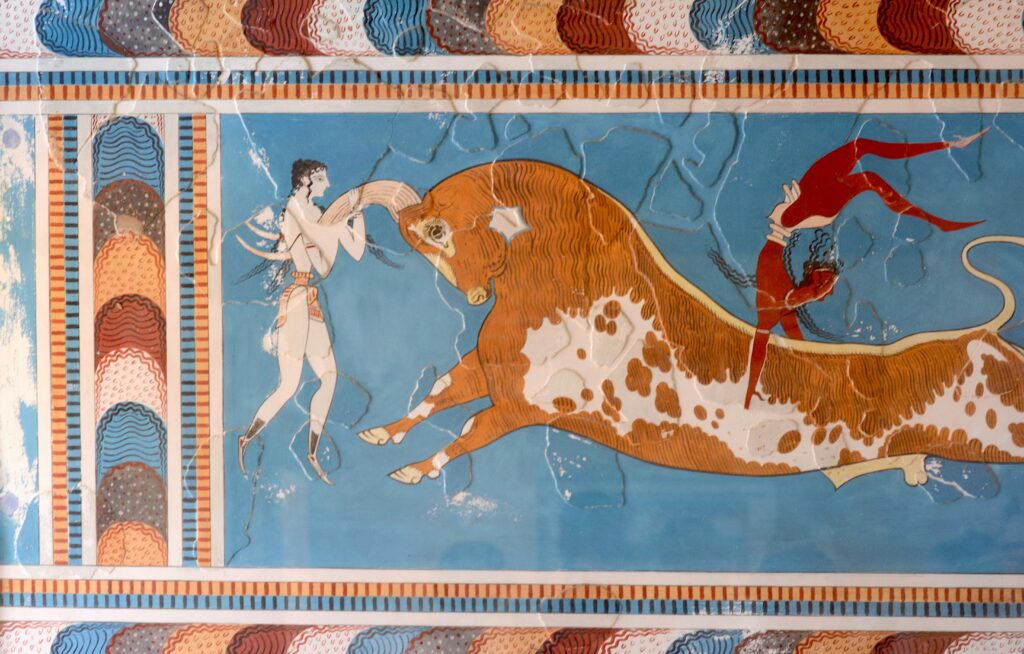
What strikes most people first about the Minoans — before the scale of the architecture, before the trading networks, before the sophisticated engineering — is the art. Minoan frescoes are unlike anything else produced in the ancient world. They are energetic, naturalistic, almost playful. They depict dolphins leaping through water, lilies swaying in a breeze, young men and women vaulting acrobatically over the backs of charging bulls. They show processions, ceremonies and gathering of saffron. Nature is everywhere — not as backdrop but as subject, rendered with genuine affection and remarkable skill.
The frescoes that decorated the walls of Knossos and the other palaces were painted with mineral pigments on wet plaster, producing colours that have survived three and a half millennia with extraordinary vividness. The best of them are now in the Heraklion Archaeological Museum — one of the finest museums in Greece, and essential viewing for anyone who wants to understand what the Minoans actually were.
The Heraklion Archaeological Museum
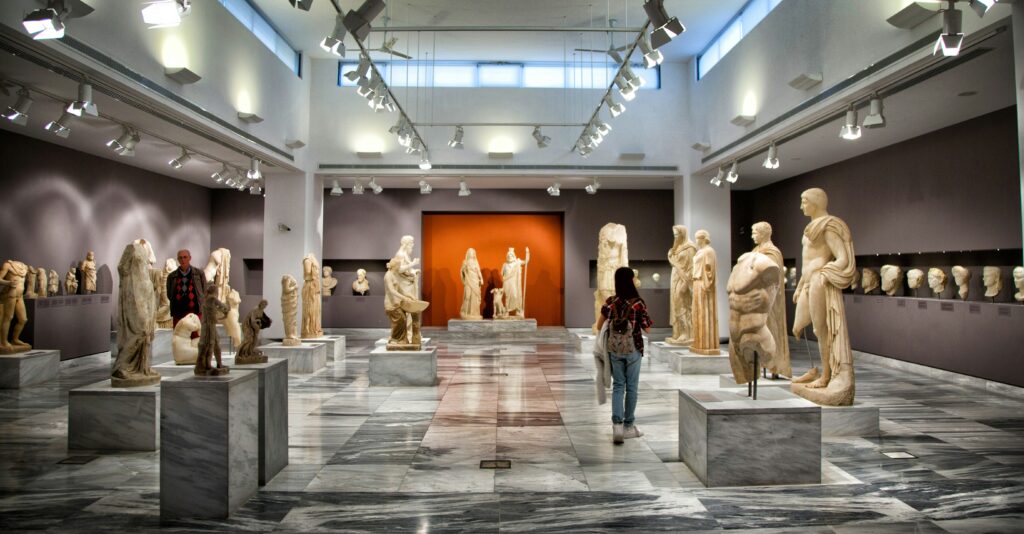
The Heraklion Archaeological Museum houses the most significant collection of Minoan artefacts in the world. The Snake Goddess figurine, the Bull’s Head rhyton, the Harvester Vase, the Toreador Fresco — these are not merely interesting objects. They are windows into a world that was, by any measure, extraordinary. Plan at least two hours. Go in the morning before the tour groups arrive. And visit Knossos first if you can — the artefacts make far more sense when you have seen the buildings they came from.
Entry to the museum is currently €20 for adults, with a reduced rate of €12. It is open daily from 8:30am, closing at 15:30 in the winter season and later in summer. Combined visits with Knossos are possible but now require separate tickets for each site.
The Mystery of Their Disappearance
Around 1450 BCE, something catastrophic happened. Palace sites across Crete show evidence of widespread destruction — fire, collapse, abandonment. The cause remains one of archaeology’s great unresolved debates.
For decades the leading theory pointed to the eruption of the Thera volcano on the island of Santorini, roughly 110 kilometres north of Crete. The eruption — one of the largest in recorded human history — would have sent tsunamis crashing into Crete’s northern coast and blanketed the island in ash, devastating agriculture. The parallel with the legend of Atlantis, a great civilisation swallowed by the sea, has led some scholars to suggest that Minoan Crete may be the origin of the myth.
Others argue the timeline doesn’t quite align, and that the destruction was caused by invasion from the Mycenaean Greeks of the mainland, who had long been trading with and learning from the Minoans. What is certain is that after around 1450 BCE, Knossos continued under what appears to be Mycenaean administration — the writing system shifts from the undeciphered Linear A to Linear B, which records an early form of Greek — before the palace was finally destroyed around 1375 BCE and the Minoan civilisation came to its end.
They left no direct descendants who remember them by name. They left no texts we can fully read. But they left Knossos, and Phaistos, and the frescoes in Heraklion, and the memory of a people who built something magnificent at the very beginning of European history — on this island, on this soil, in this light.
“They left no texts we can fully read. But they left buildings, paintings and objects that speak across three and a half thousand years with startling clarity.”
How to See the Minoans When You Visit Crete
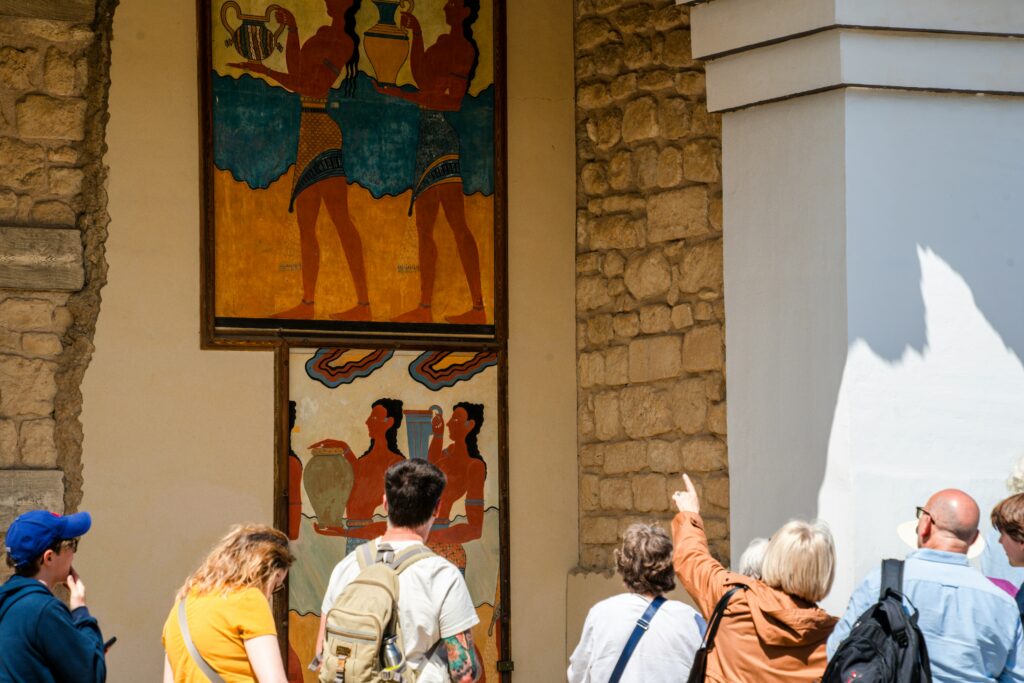
The two essential stops are Knossos and the Heraklion Archaeological Museum, both easily reached from Heraklion city centre. Knossos is five kilometres south of the city — bus number 2 runs directly there from the port, taking around twenty minutes and costing approximately €1.50 each way.
A few practical notes for your visit:
- Book tickets in advance. Knossos receives over a million visitors a year. In peak summer months the queues for tickets on the day are significant. Buy online before you arrive at knossos-palace.gr.
- Go early. Both Knossos and the museum are best visited in the morning before tour groups arrive. At the museum in particular, arriving at opening time means you may have the Minoan collection almost to yourself.
- Visit Knossos before the museum. The artefacts in Heraklion make far more sense when you have seen the buildings they came from. The spatial logic of the palace gives context to everything.
- Consider a guide. Knossos without context is a collection of ruins. With a knowledgeable guide, it becomes one of the most extraordinary places you will ever stand. Only licensed guides are permitted to conduct tours within the archaeological site.
- Allow a full day. Knossos needs one and a half to two hours minimum. The museum needs at least the same. Add travel time and a proper lunch in Heraklion and you have a full, rich day.
Frequently Asked Questions About the Minoans
Who were the Minoans?
The Minoans were a Bronze Age civilisation that flourished on the island of Crete from approximately 3000 BCE to 1100 BCE. They are considered the first advanced civilisation in Europe, known for their monumental palace architecture, vivid fresco painting, sophisticated trading networks and advanced engineering. Their language, recorded in the script known as Linear A, has never been fully deciphered.
Why did the Minoan civilisation collapse?
The cause of the Minoan collapse around 1450 BCE remains debated. Leading theories include the catastrophic eruption of the Thera volcano on Santorini, which would have caused tsunamis and widespread agricultural destruction, and invasion or takeover by Mycenaean Greeks from the mainland. Most likely, a combination of factors contributed to the end of Minoan palace culture.
Is the Palace of Knossos worth visiting?
Yes, unequivocally. Knossos is one of the most significant archaeological sites in the world and the best surviving example of Minoan palace architecture. Allow at least two hours on site, book tickets in advance, and if possible arrange a licensed guide — the site is far more meaningful with proper context. Combine with the Heraklion Archaeological Museum for the most complete experience.
Can you see Minoan ruins in Chania?
The major Minoan palace sites are in central and eastern Crete — Knossos, Phaistos, Malia and Zakros. However, Minoan history is present across the entire island, including in Chania. Our Walking Tour of Chania explores the layers of civilisation visible in the old town — from Minoan foundations to Venetian harbour walls to Ottoman minarets — and puts the island’s extraordinary depth of history in context.
See Crete’s history with someone who has lived it for 35 years.
Our Walking Tour of Chania explores the city through its layers of history — Minoan, Venetian, Ottoman and beyond — in small groups of no more than seven people. Or book Your Hour with Garry for a private conversation about everything you want to see, understand and experience on the island before you arrive.