By Maria Stavrakakis, Architect & Hidden Gems of Crete Guide · Masters in Architecture, Technical University of Crete
Most cities have one layer of history visible in their architecture. A medieval centre, or a colonial grid, or a nineteenth-century port district. Chania has eight. Walk through the old town for thirty minutes with your eyes open and you will pass through civilisations — Minoan, Greek, Roman, Byzantine, Arab, Venetian, Ottoman, modern Greek — each leaving its mark in the stone, the street pattern, the buildings themselves.
I have been studying architecture on this island for years, and I am still finding things in Chania’s old town that stop me mid-step. Not because they are hidden, exactly — most of them are in plain sight — but because the city asks a particular kind of attention that most visitors, understandably swept up in the beauty of the harbour, do not know to give it.
This is a guide to the architecture and history of Chania old town for people who want to understand what they are looking at. It begins where the city began — under our feet — and works its way forward to the present day.
“Most cities have one layer of history visible in their architecture. Chania has eight. Walk for thirty minutes and you will pass through civilisations.”
Layer One: The Minoans — What Lies Beneath
Chania stands on the site of the ancient Minoan city of Kydonia — one of the most significant urban centres in the Minoan world, dating back to at least 2000 BCE. The name Kydonia survives in the Greek word for quince, kydonion, because the fruit was cultivated here and traded across the ancient Mediterranean.
You cannot see Kydonia. It lies beneath the hill of Kastelli, the elevated area at the eastern end of the old town, buried under three thousand years of subsequent construction. But it is there — archaeologists have found Minoan buildings, Linear B tablets, pottery and seal stones under the streets of the modern city, confirming that this harbour has been in use, continuously, for over four thousand years.
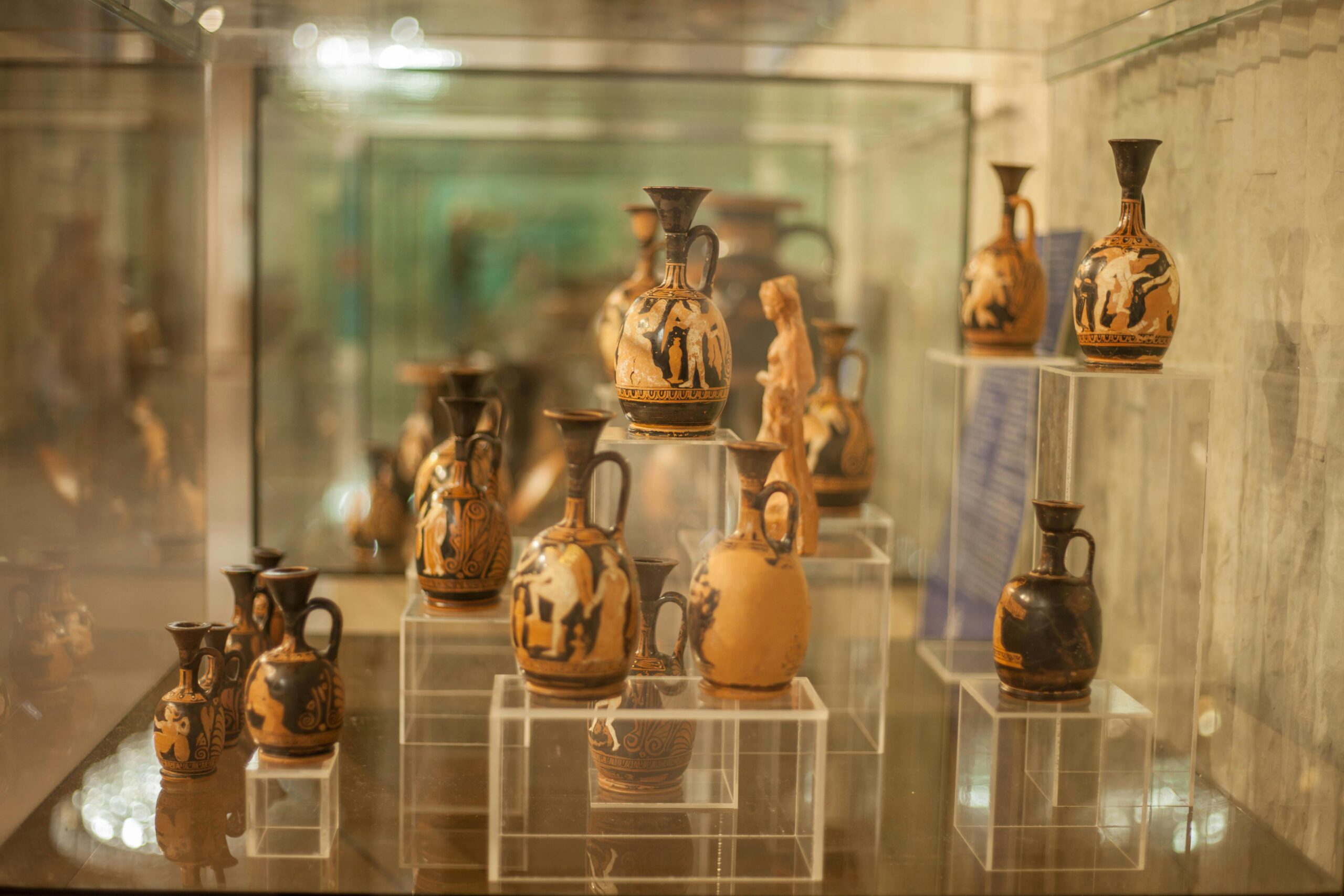
The Archaeological Museum of Chania holds a significant collection of Minoan artefacts from the region. Housed in the former Venetian monastery of Saint Francis — itself a remarkable building — it is the best place on the western side of the island to understand the Minoan foundation on which everything else in Chania rests. The Clay tablets, pottery, and jewellery excavated from beneath these streets give a tangible sense of who was here first.
Layer Two: Venetian Chania — The Architecture You Can See
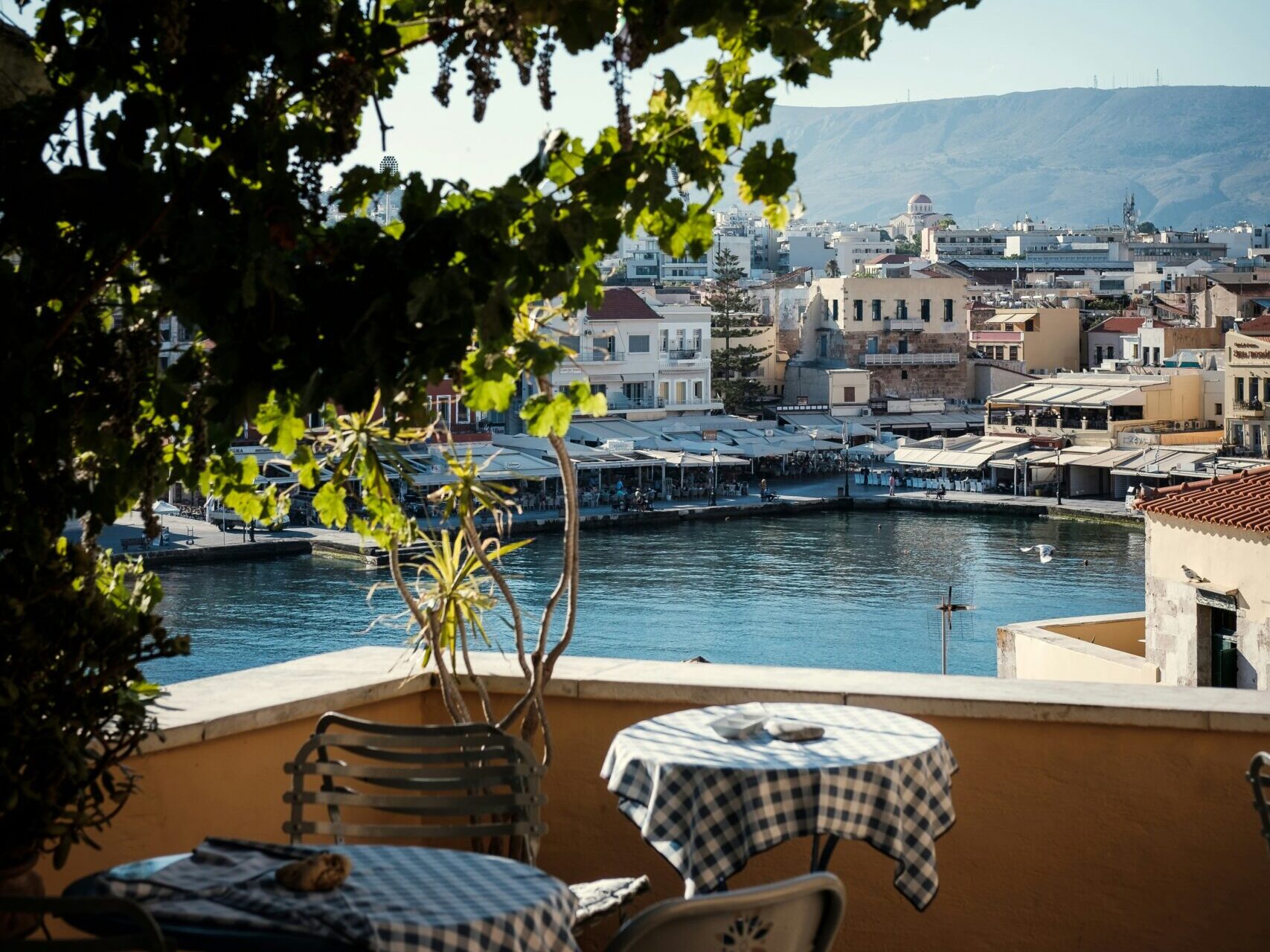
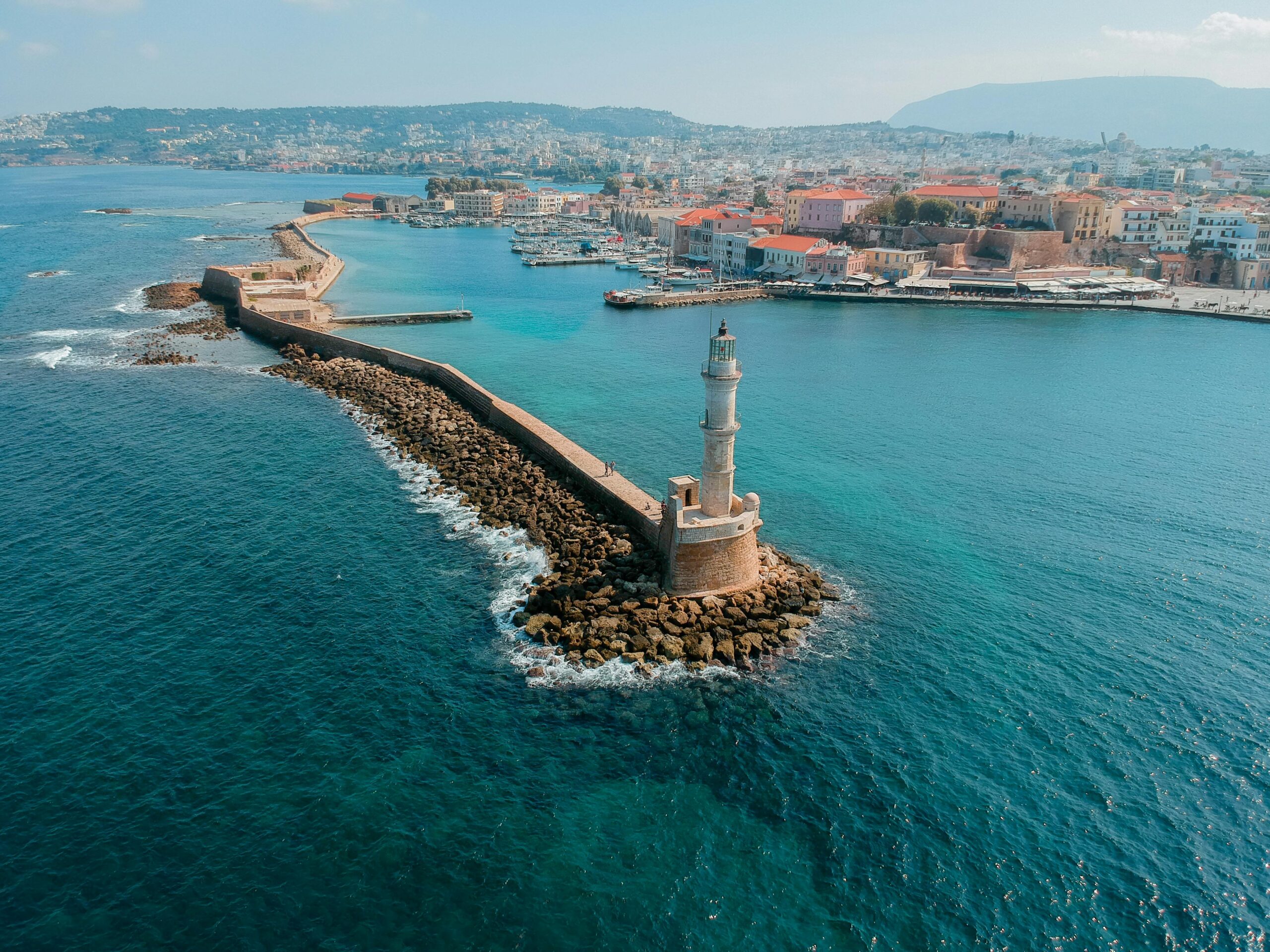
The Venetians arrived in Crete in 1204 following the Fourth Crusade and remained for over four centuries, until 1669. Their presence in Chania is more visible than any other period in the city’s history. The harbour they built between 1320 and 1356, the fortifications they raised to protect it, the shipyards they constructed along the eastern waterfront — these are the bones on which the modern old town is built.
The Venetian Harbour
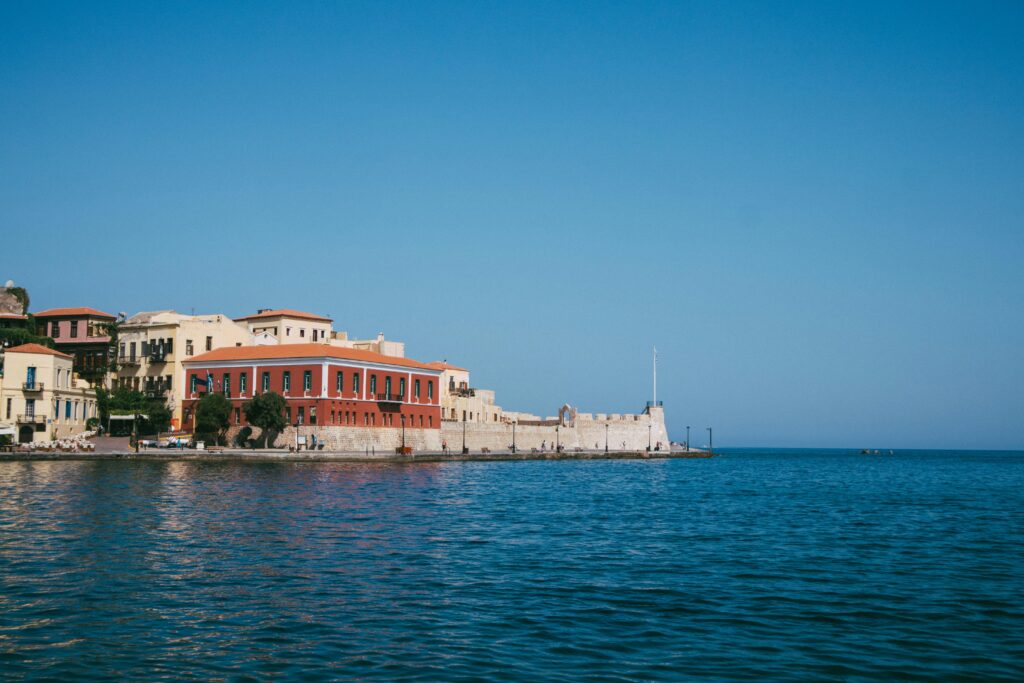
The harbour is the heart of Chania and it is, structurally, almost entirely Venetian. The curved breakwater, the arched shipyards along the eastern quay, the lighthouse at the harbour mouth — all originally Venetian construction, subsequently modified but fundamentally unchanged in their layout for seven hundred years.
The lighthouse is worth particular attention. Originally built by the Venetians in the sixteenth century, it was reconstructed in its current form — a tall minaret-like shaft on a polygonal base — by Egyptian craftsmen in the early nineteenth century during a brief period of Egyptian rule. It is, quietly, one of the most cosmopolitan objects in Chania: a Venetian foundation, rebuilt by Egyptians, standing in a Greek city. That accumulation of different hands is Chania in miniature.
The Firka Fortress and the Arsenals
At the western end of the harbour, the Firka Fortress is a well-preserved example of Venetian military architecture — massive walls of pale limestone, designed to protect the harbour entrance from naval attack. It was within these walls, in 1913, that the union of Crete with Greece was formally declared. The fortress now houses the Maritime Museum of Crete, which tells the story of the island’s naval history from antiquity to the twentieth century.
Along the eastern side of the harbour, the Venetian arsenals — the shipyards where galleys were built and repaired — still stand largely intact. Their long arched openings, designed to allow ships to be drawn in from the sea, are one of the finest surviving examples of Venetian industrial architecture outside Venice itself. The largest, the Grand Arsenal, has been converted into a cultural venue and architecture centre. Walk inside and look up at the vaulting: it is engineering of extraordinary confidence.
The Streets of the Old Town
The street pattern of Chania old town is Venetian. The narrow, irregular lanes that make the city so pleasurable to walk — and so easy to get happily lost in — follow the property boundaries established by Venetian landlords in the thirteenth and fourteenth centuries. Many of the buildings that line these streets are Venetian in their bones, even if they have been modified, rebuilt or repurposed many times since.
Look for: arched doorways with carved stone surrounds; protruding first floors on corbels, a Venetian way of maximising ground-floor commercial space; carved stone coats of arms above doorways, the marks of wealthy Venetian families who built here. They are everywhere, once you know what you are looking for.
Layer Three: Ottoman Chania — The Eastern Additions
The Ottomans took Chania in 1645 after a two-month siege. They held it until 1898 — two and a half centuries of rule that left a distinctive layer on the city’s architecture.
The Mosque of the Janissaries
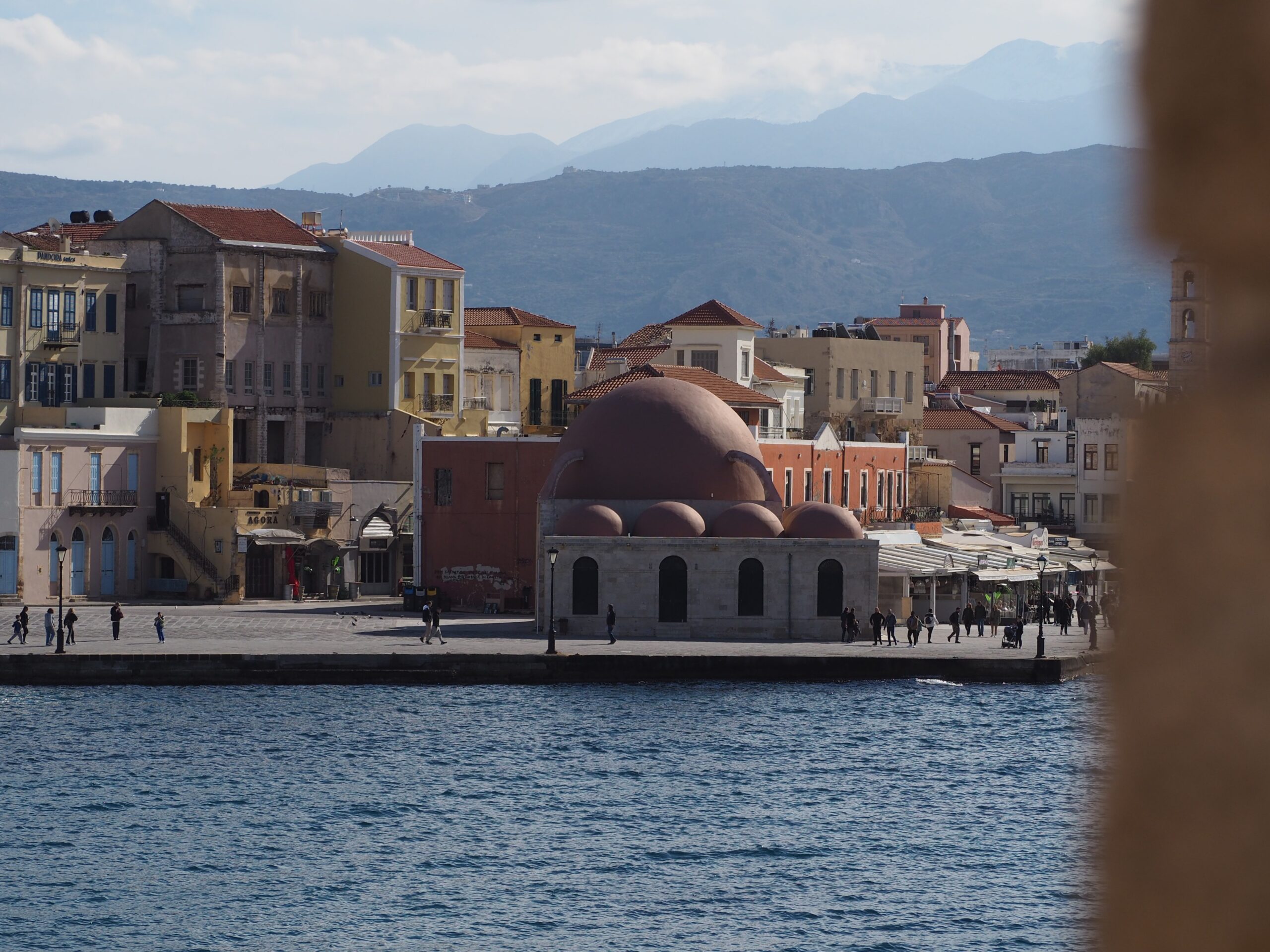
The Kucuk Hasan Mosque — the Mosque of the Janissaries — sits directly on the harbour front at the eastern end of the main quay and is the oldest Ottoman building on Crete, built in 1645 in the same year the city fell. Its low dome and portico, built on the foundations of an earlier church, read as distinctly different from the Venetian buildings around it — rounder, more horizontal, more concerned with shelter than with height.
It is now used as an exhibition space and gallery. Walk inside when it is open. The interior, with its single large domed space and simple stone floor, has a quality of light and stillness that is genuinely affecting. It is one of the few Ottoman buildings in Greece that has been treated with the architectural seriousness it deserves.
Agios Nikolaos Church — A Building That Changed Religions Twice
In the Splantzia quarter, a few minutes’ walk from the harbour, Agios Nikolaos Church is one of the most architecturally remarkable buildings in Chania — and one of the least remarked upon by visitors. It began as a Dominican monastery church built by the Venetians. The Ottomans converted it into a mosque, adding a minaret. After 1913 it became a Greek Orthodox church, and the bell tower was added alongside the existing minaret.
It is, therefore, a building that contains three religions simultaneously — the Latin cross plan of the Catholic original, the minaret of the Islamic conversion, and the bell tower of the Orthodox restoration. As a physical record of Chania’s layered history, nothing else in the city quite matches it. Stand in Splantzia Square and look at it properly. It is extraordinary.
Layer Four: The Splantzia Quarter — The Best Walk in Chania
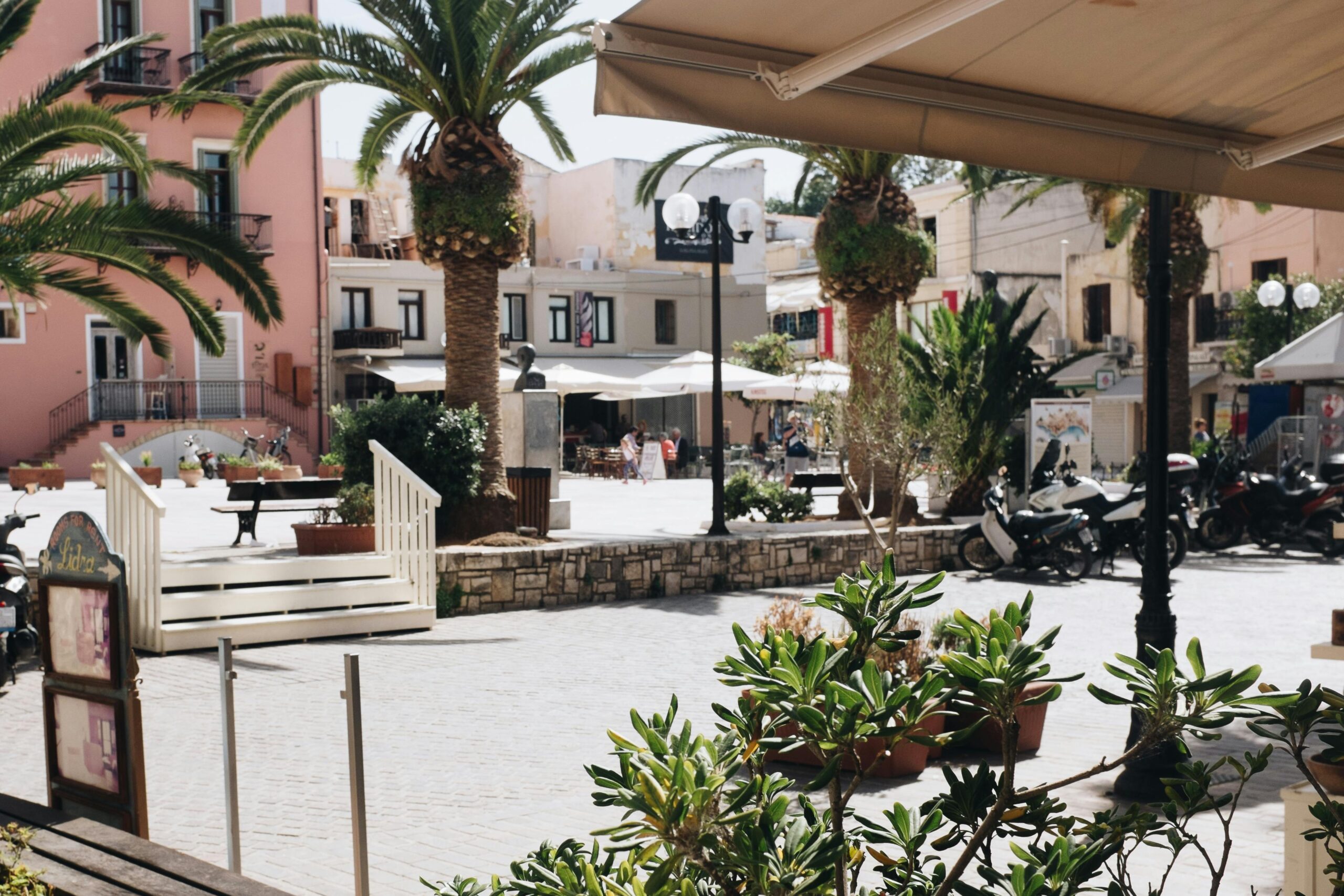
Splantzia is the neighbourhood immediately east of the main harbour, and it is, in my view, the finest part of the old town to walk. It is less touristic than the harbour front, its streets are quieter, and its architecture is more varied and more intimate.
The central square — now called 1821 Square, commemorating the Greek War of Independence — is anchored by an enormous plane tree that has been growing here for centuries. Local cafes face the square. Cats sleep on the stone steps. The pace is entirely different from the harbour.
Walking through Splantzia’s backstreets, you encounter: carved Venetian doorways, half-collapsed Ottoman houses slowly being restored, small Byzantine churches tucked between apartment buildings, Arabic inscriptions above doorways that most people walk past without noticing. This is Chania without its tourist face — authentic, worn, beautiful in a way that rewards patience.
How to Walk the Old Town With Your Eyes Open
- Look up. The most interesting architectural details in Chania are above eye level — carved stone surrounds, Ottoman decorative plasterwork, Venetian coats of arms. Most visitors look at the shop windows and miss the history above them.
- Go into the Kastelli area. The elevated ground at the eastern end of the harbour is the oldest part of the city — the site of Minoan Kydonia. The streets here are steeper, quieter and less visited. The views over the harbour from the Byzantine walls are among the best in Chania.
- Visit the Archaeological Museum. Housed in the former Venetian monastery of Saint Francis, it connects the objects found under these streets to the streets themselves. An hour here makes everything you see outside more meaningful.
- Walk at dusk. The limestone of Chania’s buildings takes the evening light differently from any time of day. The harbour at dusk, when the stone walls turn amber and the water becomes still, is when the city is most completely itself.
- Take the walking tour. There is a limit to what you can understand about a place without a guide who knows its specific history. Our Walking Tour of Chania covers the layers in detail — the Minoan foundations, the Venetian harbour, the Ottoman additions, the neighbourhood politics — in two and a half hours with a maximum of seven people.
Frequently Asked Questions About Chania Old Town
How old is Chania old town?
The site of Chania has been continuously inhabited for at least four thousand years, since the Minoan period. The street pattern and harbour of the old town as it appears today are largely Venetian, dating from the thirteenth to seventeenth centuries. The buildings represent a mix of Venetian, Ottoman, Byzantine and modern Greek construction layered over those foundations.
What is the most important landmark in Chania old town?
The Venetian harbour is the defining landmark — the lighthouse, the arsenals and the curved breakwater are all genuinely significant pieces of architecture. For historical depth, Agios Nikolaos Church in Splantzia, with its combination of Catholic, Islamic and Orthodox architectural elements, is arguably the most remarkable single building in the city.
How long do you need in Chania old town?
A minimum of one full day to see the main landmarks and walk the principal areas. Two or three days to begin to understand the neighbourhood character of different quarters — Kastelli, Splantzia, the harbour front, the Jewish quarter. The old town is small enough to walk entirely in a day but rich enough to sustain a week of curious exploration.
Is there a walking tour of Chania old town?
Yes — our Walking Tour of Chania covers the old town’s architectural and historical layers in two and a half hours, with a maximum of seven people. We move through the Venetian harbour, the Ottoman quarter, the Splantzia neighbourhood and the Kastelli hill, reading the buildings and streets as the historical record they are. The tour runs regularly throughout the season. Details and booking at hiddengemsofcrete.com.